The Meta Subscription Trap
Why Meta’s Future Creates an Opening for the Next Great Social Platform

For nearly two decades, Meta sold the world on a simple bargain.
Use Facebook. Use Instagram. Use WhatsApp. Use them for free.
In exchange, Meta would monetize attention through advertising, harvesting enough data and engagement to build one of the most profitable businesses in history.
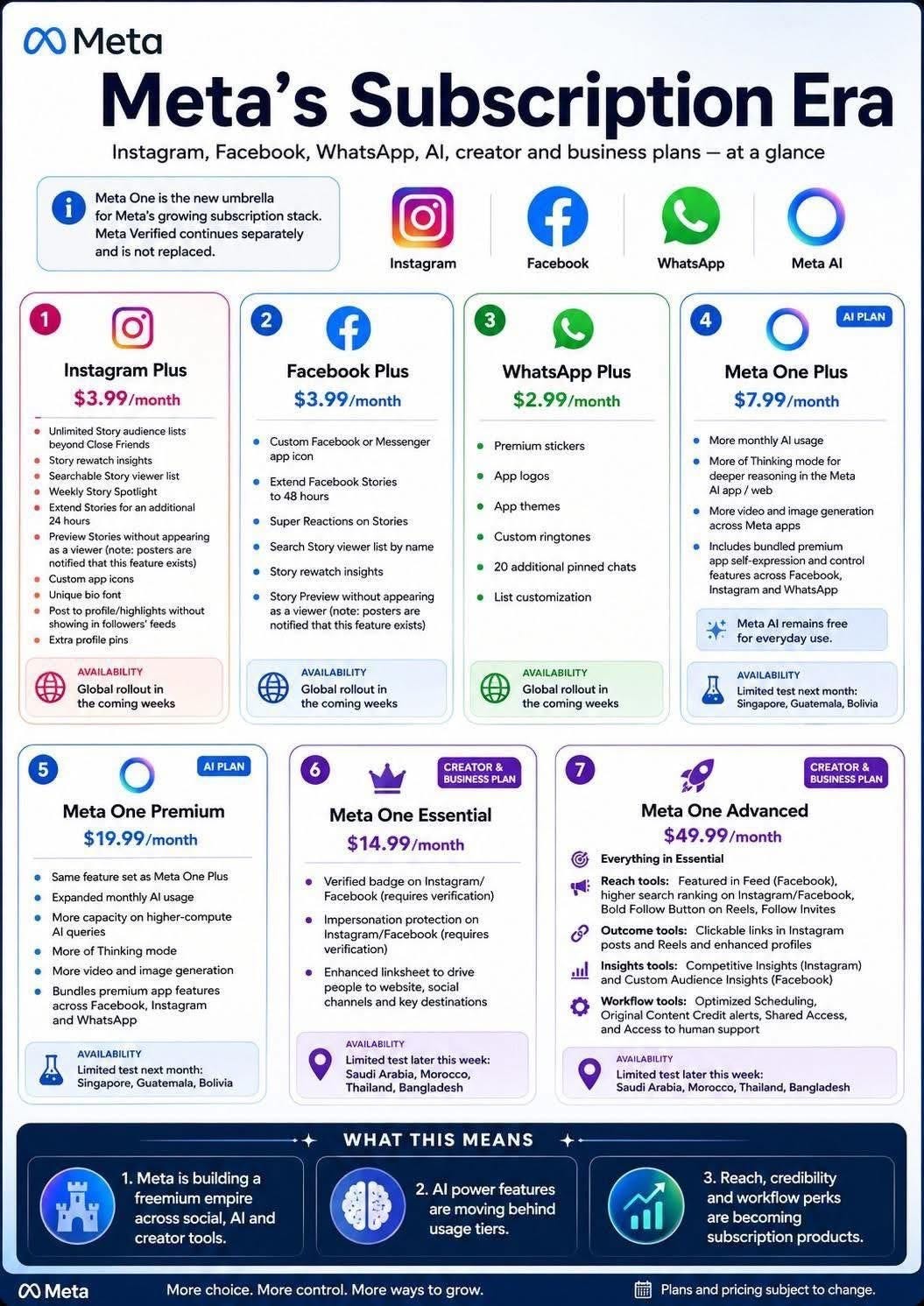
The image below suggests that bargain is changing.
What Meta is quietly unveiling is not simply a collection of premium plans. It is evidence that the economics of social media are shifting in ways that may permanently alter the relationship between platforms, creators, businesses, and users.
And history suggests that when dominant platforms begin charging for features once considered part of the experience, disruption is rarely far behind.
The End of “Free”
The infographic outlines a growing ecosystem of paid services:
Instagram Plus ($3.99/month)
Facebook Plus ($3.99/month)
WhatsApp Plus ($2.99/month)
Meta One Plus ($7.99/month)
Meta One Premium ($19.99/month)
Meta One Essential ($14.99/month)
Meta One Advanced ($49.99/month)
The offerings range from AI access and profile enhancements to business tools, creator visibility, audience analytics, workflow systems, and premium placement.
What’s striking isn’t the pricing.
It’s what is being monetized.
Once upon a time, social media companies competed by offering more capabilities for free. Every update promised additional reach, better discovery, stronger community building, and more expressive tools.
Now Meta appears to be placing a tax on many of those advantages.
The infographic’s own summary makes the point plainly:
AI power features are moving behind usage tiers.
And that’s where the strategic risk begins.
The Reach Tax
The most revealing section may be Meta One Advanced.
For $49.99 per month, creators and businesses receive:
Featured placement
Higher search rankings
Enhanced profile visibility
Audience insight tools
Workflow optimization
In other words, Meta is increasingly selling reach.
That creates a subtle but powerful shift.
For years, creators accepted declining organic reach because the platforms remained free. The frustration was tolerable because participation carried little direct cost.
But when visibility itself becomes a subscription product, creators begin asking a different question:
“If I have to pay anyway, why am I paying Meta?”
The moment creators start viewing a platform as a vendor rather than a community, loyalty weakens.
The AI Squeeze
The infographic also reveals Meta’s broader strategy.
AI is becoming the company’s new revenue engine.
Meta One Plus promises more AI usage.
Meta One Premium promises more compute power.
The company is essentially creating usage tiers similar to cloud computing services, streaming media, the cell provider you are using to read this.
This makes perfect business sense.
Large language models and image generation systems are expensive to operate. Every prompt consumes resources. Every generated image has a cost.
The challenge is that AI is rapidly becoming commoditized.
Open-source models improve monthly.
Specialized AI tools continue appearing.
Competitors can offer similar capabilities at lower prices because they don’t carry Meta’s enormous infrastructure burden.
As AI becomes ubiquitous, consumers may become less willing to pay premium prices merely because the service is bundled inside Facebook or Instagram.
The Innovator’s Dilemma in Real Time
The image reveals a company attempting to solve a classic mature-business problem.
Growth is slowing.
Advertising markets fluctuate.
Investors expect continued revenue expansion.
The answer is subscriptions.
But subscriptions create friction.
Friction creates dissatisfaction.
Dissatisfaction creates opportunity.
This is the same cycle that weakened cable television.
It is the same cycle that opened doors for streaming services.
It is the same cycle that allowed Facebook itself to overtake MySpace.
Every dominant platform eventually becomes so focused on monetizing its existing audience that it creates openings for competitors willing to offer a simpler experience.
What the Next Disruptor Might Look Like
The next serious challenger to Facebook and Instagram probably won’t win by being bigger.
It will win by being simpler.
Imagine a platform that offers:
Genuine chronological feeds
Transparent algorithms
Creator ownership of audiences
Portable follower lists
AI tools included without confusing tiers
Low advertising loads
Community-first design
Most importantly, it would need a business model aligned with users rather than attention extraction. Sounds a lot like the current Substack business model.
The history of technology suggests that consumers eventually migrate toward products that feel fair. And a lot of us don’t like many dimensions of the current Meta platforms.
When users begin to believe they are being charged repeatedly for features that once felt inherent to the experience, alternatives suddenly become attractive.
Meta’s Paradox
Meta’s subscription strategy may be financially brilliant.
In the short term, it could generate billions in recurring revenue while helping offset AI infrastructure costs.
But every subscription tier sends a message.
Every premium feature tells users that something valuable now requires payment.
Every reach enhancement reminds creators that visibility is no longer entirely earned.
Every AI usage limit reminds users that the free experience has boundaries.
That doesn’t mean Meta is doomed. Far from it.
The company remains one of the most powerful technology organizations on Earth.
Yet the infographic inadvertently reveals something important.
Meta’s future growth increasingly depends on convincing users to pay for advantages inside a system they once joined for free.
And throughout the history of technology, that moment has often marked the beginning of a new opportunity.
Somewhere, right now, another founder is looking at Facebook and Instagram and asking a simple question:
“What if we gave people back the things Meta is starting to charge for?”
If that founder finds the right answer, the next social revolution may already be underway.
Thanks for sharing. I hadn’t taken this in. I pray you are right and a new entrepreneur arrives.