Peter Samuelson - Finding Happy
The Arithmetic of Happiness

Hear the Conversation | Get the Book
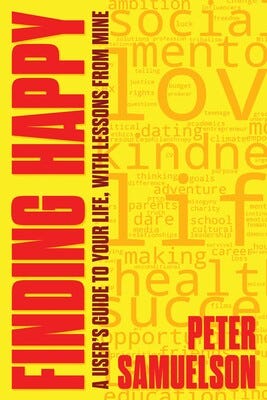
Peter Samuelson has the look of a man who long ago discovered that life is less a ladder than a series of trapdoors. The trick is not avoiding the fall but learning whom to pull up with you. A film producer by trade, a philanthropist by instinct, and a storyteller by force of personality, Peter has spent decades turning private compassion into public architecture. His 2025 book, Finding Happy: A User’s Guide for Your Life with Lessons from Mine, is not so much a memoir as a field manual for the young, the searching, and the occasionally bewildered adult who still suspects that meaning may be hiding somewhere beyond ambition.
Peter’s definition of happiness is bracingly unsentimental. There is, he tells me, the short-term variety, the sort found in a bed and a bucket of chocolate ice cream. Then there is the durable kind, the one that comes not from acquisition but from usefulness. Happiness is not grabbed. It is generated. It appears when one pushes help outward and, in doing so, discovers an inner agency that no résumé, algorithm, or applause meter can confer.
That idea might sound like sermonizing if Peter had not spent a lifetime testing it in the unruly laboratory of the real world. He helped create the Starlight Children’s Foundation, co-founded Starbright World with Steven Spielberg, launched First Star to help foster youth reach college, and developed EDAR as a practical response to homelessness. The statistics behind First Star alone are stunning. Only a small percentage of American foster youth typically make it to college. And yet, First Star’s academies send most of their high-school seniors on to college or vocational training. The program gives young people not only academics, but continuity, community, and the radical experience of being expected to thrive.
Finding Happy grew from this work. Peter realized, after mentoring hundreds of young adults, that their anxieties had patterns: risk, friendship, love, ambition, bullying, parents, police encounters, health, school, and the aching question of what one is supposed to do with a life. His answer is practical, funny, and occasionally terrifying. One anecdote has him, as a young man in Marrakech, climbing naked down a hotel pipe duct to rescue a kitten, only to discover that compassion without forethought can leave one filthy, stranded, and nearly dead. The lesson is not “be less kind.” It is “bring the front of your brain.”
The book’s deepest argument is that love, especially unconditional love, is not ornamental. It is structure. Samuelson’s story of a frightened foster girl unable to sing at a talent show, then shielded by her entire cohort until her voice emerges is the kind of scene that explains a life’s work better than any mission statement could.
Peter Samuelson’s gospel is simple: volunteer. Start anywhere. Dogs, children, shelters, classrooms, hospitals. Do something useful. Happiness may follow, not as a reward, but as evidence that the self was never meant to be its own final destination.